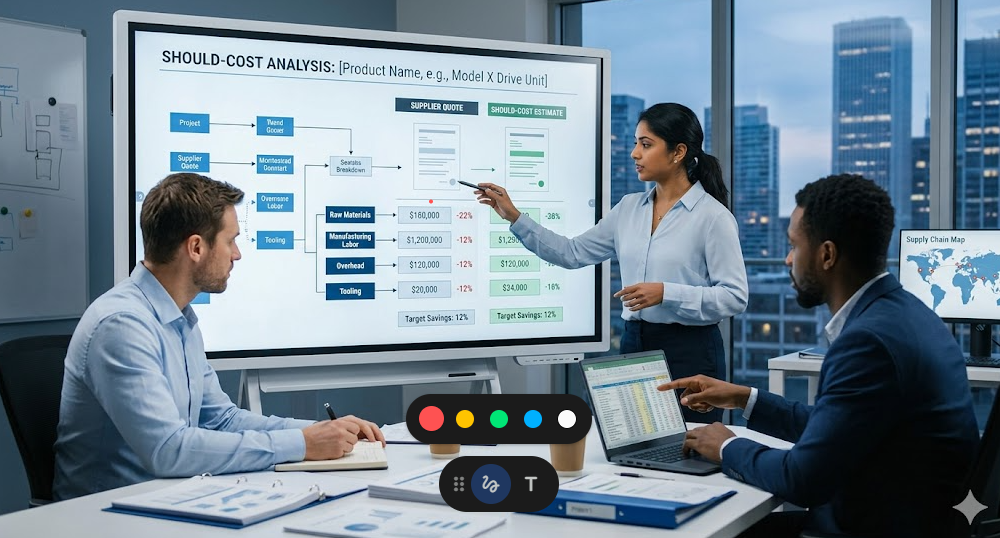
Should-Cost Analysis is a cost estimation method used in procurement, manufacturing, and supply chain management to determine what a product or service should cost based on its actual components — rather than simply accepting a supplier’s quoted price.
How It Works
Instead of asking „what does the supplier charge?“, should-cost analysis asks:
„Given the materials, labor, overhead, and profit required — what SHOULD this cost?“
It breaks down a product or service into its fundamental cost drivers:
- Direct Materials — raw materials, components, parts
- Direct Labor — time × labor rate for each manufacturing step
- Manufacturing Overhead — equipment, energy, facility costs
- Selling, General & Administrative (SG&A) — indirect business costs
- Profit Margin — a reasonable return for the supplier
Why Companies Use It
- Negotiation leverage — enter supplier negotiations with data, not guesses
- Identify cost reduction opportunities — spot where a supplier may be padding margins
- Make vs. buy decisions — evaluate whether to produce in-house or outsource
- Supplier benchmarking — compare quotes across multiple vendors fairly
- Design feedback — inform engineers on how design choices affect cost
Example
A buyer wants to source a metal bracket. Instead of just accepting a $15/unit quote, they build a should-cost model:
| Component | Cost |
|---|---|
| Steel material | $3.20 |
| Stamping labor (2 min @ $30/hr) | $1.00 |
| Tooling amortization | $0.50 |
| Overhead (80% of labor) | $0.80 |
| SG&A (10%) | $0.55 |
| Profit (8%) | $0.48 |
| Should-Cost Total | ~$6.53 |
The $15 quote now looks significantly inflated, giving the buyer a strong basis to negotiate.
Who Uses It
It’s widely used in automotive, aerospace, defense, electronics, and consumer goods — any industry with complex supply chains and high purchase volumes. Companies like Toyota, Boeing, and Apple are known for rigorous should-cost modeling.
In short, it shifts the buyer from a reactive to a proactive position in cost management.