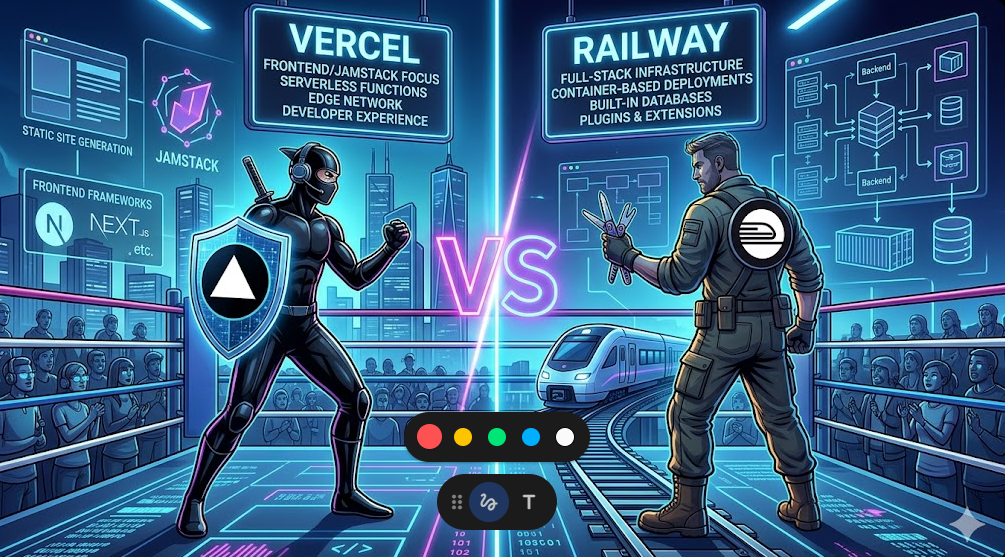
Choosing the right deployment platform can save your team weeks of DevOps work — or cost you dearly in scalability later. Two platforms that frequently come up in developer discussions are Vercel and Railway. Both promise to simplify deployment, but they’re built for different workflows and types of applications. This guide breaks down what each platform does best and helps you decide which one belongs in your stack.
What Is Vercel?
Vercel is a cloud platform built primarily for frontend developers and modern web applications. Founded by Guillermo Rauch (also the creator of Next.js), Vercel has carved out a dominant position in the „Frontend Cloud“ space. At its core, it takes your code from a Git repository and deploys it globally with zero configuration required.
Vercel’s biggest strength is its seamless integration with Next.js, React, Vue, and other modern frontend frameworks. When you push a commit, Vercel automatically builds and deploys your app to a global Content Delivery Network (CDN) with points of presence around the world — meaning pages load in milliseconds for users anywhere on the planet.
Key Features of Vercel
- Global Edge Network & CDN: Assets and pages are served from the nearest location to the user automatically, with no extra configuration needed.
- Serverless & Edge Functions: Run backend logic — authentication, API calls, data fetching — without managing servers. Functions scale to zero when idle and spin up on demand.
- Preview Deployments: Every pull request generates a unique, shareable URL so your team can review changes in a live environment before merging.
- Incremental Static Regeneration (ISR): Update static pages in the background without triggering a full rebuild — ideal for content-heavy sites.
- Automatic HTTPS & DDoS Protection: Free SSL certificates and a built-in Web Application Firewall are enabled by default on every deployment.
- Git Integration: Connects with GitHub, GitLab, and Bitbucket. Every push to any branch triggers an automated build and deployment pipeline.
- Fluid Compute: The latest compute model bills by active CPU time, not wall-clock time — making it cost-efficient for AI workloads and I/O-heavy tasks.
- Analytics & Observability: Built-in Core Web Vitals tracking and performance monitoring from the dashboard.
What Is Railway?
Railway is a full-stack cloud deployment platform often described as the modern successor to Heroku. Where Vercel focuses on the frontend layer, Railway is designed to run anything: APIs, backend services, databases, cron workers, and full-stack applications — all from a single, clean dashboard.
Railway’s philosophy is „take your code, build it, run it.“ Point it at a GitHub repo (with or without a Dockerfile), and its Railpack build system analyzes your code, generates an optimized container image, and deploys it to production. No YAML configuration marathons, no Kubernetes expertise required.
Key Features of Railway
- Managed Databases: One-click provisioning of PostgreSQL, MySQL, MongoDB, and Redis — all running alongside your application services in the same project.
- Persistent Volumes: Attach disk storage to services for file uploads, media pipelines, or self-hosted databases. Storage persists across deploys and restarts.
- Cron Jobs & Background Workers: Schedule recurring tasks natively — daily jobs, queue processors, data sync tasks — without a separate task scheduler service.
- Private Networking: Services within the same project communicate over a secure high-speed internal network, reducing latency and egress costs.
- Templates Marketplace: Hundreds of pre-built templates (Next.js, FastAPI, Ghost, Hasura, WordPress, and more) let you deploy common stacks with a single click.
- Railway Metal: Railway’s own hardware and anycast edge network, delivering faster routing, lower egress costs (up to 50% cheaper), and better performance.
- Horizontal & Vertical Scaling: Scale CPU/RAM manually or automatically based on workload. Add replicas for high-traffic services without leaving the dashboard.
- Usage-Based Pricing: Pay only for RAM hours, CPU hours, and storage you actually consume — ideal for projects with variable or spiky traffic.
Vercel vs Railway: Head-to-Head Comparison
Understanding where each platform excels comes down to what layer of your application you’re deploying:
| Feature | Vercel | Railway |
|---|---|---|
| Primary Focus | Frontend & JAMstack | Full-stack & backend services |
| Database Hosting | Limited (via integrations) | Native, one-click provisioning |
| Long-Running Processes | Limited (max 300s functions) | Full support (persistent containers) |
| Cron Jobs | Via Vercel Cron (basic) | Native, reliable cron scheduling |
| Persistent Storage | Not natively supported | Persistent volumes included |
| Next.js Support | Best-in-class (built by same team) | Good (via templates) |
| Framework Flexibility | Frontend-optimized | Any language / any Docker container |
| CDN / Edge Network | Global, built-in | Metal Edge Network (expanding) |
| Preview Deployments | Yes, per pull request | Yes, per environment |
| Pricing Model | Usage-based (Fluid Compute) | Usage-based (RAM/CPU hours) |
Best Use Cases for Vercel
Vercel shines when your primary deliverable is a fast, globally distributed web experience. Here’s where it truly excels:
1. Next.js and React Applications
Vercel was built by the same team that created Next.js, so the two are designed to work together perfectly. Features like Server Components, ISR, and Edge Middleware all perform optimally on Vercel’s infrastructure.
2. Marketing Sites and Landing Pages
Static and semi-static sites benefit enormously from Vercel’s global CDN. Pages load in under a second worldwide, Core Web Vitals scores improve, and SEO rankings follow. For e-commerce storefronts or product pages where page speed directly impacts conversion, Vercel is a natural fit.
3. Teams with Rapid Iteration Cycles
The preview deployment system is one of Vercel’s most underrated features. Designers, product managers, and QA can review every pull request as a live, shareable URL — eliminating the „works on my machine“ problem and speeding up code review cycles significantly.
4. AI-Powered Web Applications
With the launch of Fluid Compute and Vercel’s AI SDK, the platform is increasingly positioned for AI-native applications — streaming LLM responses, deploying AI agents, and running inference workloads where billing by active CPU time (not wall time) makes economic sense.
Best Use Cases for Railway
Railway is the right tool when your project needs persistent services, databases, or backend logic that Vercel’s serverless model can’t accommodate cleanly.
1. Full-Stack SaaS Products
Solo developers and small teams building SaaS applications can run their API, database, Redis cache, and background workers — all within a single Railway project. The usage-based pricing means infrastructure costs scale with revenue rather than requiring upfront capacity commitments.
2. APIs and Microservices
Railway’s private networking lets backend microservices communicate over a secure internal network without exposing them to the public internet. This is ideal for architectures where a public-facing Vercel frontend talks to private Railway-hosted APIs and databases.
3. Startups Prototyping MVPs
Railway’s template marketplace lets teams spin up a full-stack environment — app server, database, cache — in minutes. The combination of Nixpacks auto-detection, managed databases, and one-click templates means a working prototype can be live before the competition has finished configuring their VPCs.
4. Projects Requiring Persistent State
File uploads, media processing pipelines, self-hosted databases, or any application that needs to read and write to disk across requests requires persistent volumes — something Vercel’s serverless model doesn’t natively support but Railway handles out of the box.
Can You Use Both Together?
Absolutely — and many production teams do. A common architecture pairs Vercel for the frontend (Next.js app with global CDN, preview deployments, and ISR) with Railway hosting the backend API, managed PostgreSQL database, and Redis cache. The frontend makes API calls to Railway’s services, getting the best of both worlds: blazing-fast UI delivery from Vercel and robust, stateful backend infrastructure from Railway.
This split also has a practical cost advantage: Vercel optimizes the public-facing layer where CDN performance matters most, while Railway’s usage-based pricing keeps backend costs lean during low-traffic periods.
Which Platform Should You Choose?
The decision usually comes down to one question: what are you primarily deploying?
Choose Vercel if you’re building a Next.js or React frontend, need a globally fast CDN, want instant preview deployments for your team, or are building AI-powered web interfaces where serverless execution makes sense.
Choose Railway if you need to run persistent backend services, want managed databases alongside your app, require cron jobs or background workers, or want to deploy any language or framework without being constrained to a frontend-first model.
Both platforms represent a genuine improvement over the complexity of managing raw cloud infrastructure. In 2025, the smartest teams aren’t choosing one over the other — they’re using both in concert to ship faster without sacrificing reliability.