Imagine looking at the stock market scoreboard one day in July 2026 and thinking, „Huh, quiet day.“ The S&P 500 barely budged. But under that calm surface, one of the most popular trades on the planet was quietly getting demolished. Traders had a name for it: the momentum crash. Here’s what actually happened, in language that doesn’t require a finance degree.
First, two words you need: „beta“ and „momentum“
Beta is just a measure of how wild a stock is compared to the overall market. If the market is a person walking at a steady pace, a low-beta stock walks right alongside it. A high-beta stock is the friend who sprints ahead when things are good and face-plants when things go bad. Same direction, bigger swings, in both directions.
Momentum is a strategy built on one simple idea: stuff that’s been going up tends to keep going up, at least for a while. So „momentum investors“ basically buy the winners and ride them. It’s the market version of „the popular kid keeps getting more popular.“
Now smash those two ideas together and you get high-beta momentum: the fastest-moving winners in the market. In 2026 that meant AI chips, memory makers, and semiconductor stocks. This basket had a record run of roughly 57% in the first half of the year. Everyone wanted a piece. Which, as you’ll see, was exactly the problem.
What actually happened
Over a couple of days in mid-July, that turbocharged winning trade went into free-fall. Goldman Sachs tracks a „high-beta momentum“ basket, and it dropped about 18% in two days, its worst two-day slide since the Covid crash. Zoom out to the first half of July and it was down roughly 24%, the worst stretch since 2009.
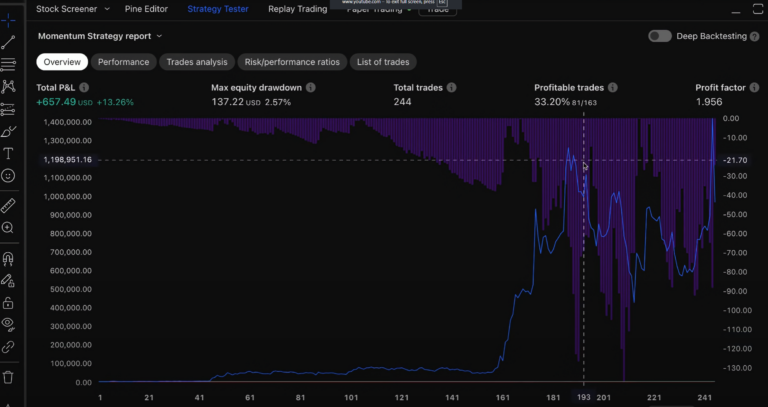
The tech-specific numbers were even more jaw-dropping. Morgan Stanley’s tech-momentum gauge posted its worst reading in the 27 years the desk has tracked it. A Goldman partner pointed out that the tech-momentum factor fell about 40% from its peak in just 17 trading days, calling it the fastest and deepest drawdown on record. The Philadelphia Semiconductor Index slipped into a technical bear market, with memory-chip stocks doing most of the damage.
Here’s the twist that confused everyone: the headline indexes looked fine. The S&P 500 dipped only around 1.5%, and more than half of its stocks actually rose that day. It was like a boat where everyone crowded onto one side, that side tipped violently into the water, and yet the boat itself stayed afloat because the other side was totally calm.
Why did the popular trade blow up?
Four things hit at basically the same time, which is why it was so violent.
- Everyone was already in. When a trade gets this popular, there’s nobody left to buy it. So the moment people start selling, there are no fresh buyers to catch the falling knife. The exit door is always way narrower than the entrance.
- Leverage lit the fuse. In Asia, „leveraged ETFs“ tied to single chip stocks (like Korea’s SK Hynix) had ballooned in size. These funds use borrowed money to double their bets, and when the underlying stocks dipped, the funds were forced to sell to rebalance. That selling pushed prices lower, which forced more selling. A doom loop. Korea even moved to halt new listings of these products mid-week.
- The AI story got a scare. A powerful new Chinese AI model landed and cracked the comfortable assumption that U.S. companies had an unbeatable lead in AI. When the whole trade is built on that assumption, any crack matters.
- Oil and geopolitics came back. Renewed tensions with Iran spiked oil prices and reminded everyone of a macro risk the momentum crowd had basically stopped worrying about.
Think of it like a super-crowded party where everyone’s dancing on one side of the floor. Someone smells smoke, and suddenly everyone rushes for the single exit at once. Nothing was structurally wrong with the building, but the stampede itself does the damage.
Important: this was NOT a market crash
This is the part that trips people up. What happened is called a factor crash or a momentum unwind, not a broad market meltdown. The difference matters a lot.
In a normal crash, everything falls because people are scared about the actual economy. This time, the economy looked healthy. Big banks reported strong earnings, corporate loan growth hit a record, and consumer spending was still solid. The pain was concentrated almost entirely in the year’s most crowded winners, not the whole market. In other words, it was a positioning problem, too many people betting the same way, rather than a „the economy is breaking“ problem.
So what happens next?
Nobody has a crystal ball, but there are a couple of useful patterns. Goldman’s own data notes that after the momentum factor drops more than 20% in a month, the following weeks have historically tended to bounce, with gains in the low-to-mid single digits on average. So a violent unwind like this is often closer to a reset than the start of something apocalyptic.
The bigger theme analysts are watching is rotation. Momentum isn’t disappearing, money is just moving out of the narrow band of red-hot AI and chip names and into the broader, more boring parts of the market that got ignored during the mania. That kind of leadership change tends to play out over months, not days, so more bumps are possible. Meanwhile, some big investors framed the whole thing as a „summer reset“ in an AI boom they still believe in long-term.
The takeaway for a normal person
You don’t need to trade any of this to learn from it. The lesson is old and keeps repeating: when everyone piles into the same „sure thing,“ the trade becomes fragile precisely because it’s so popular. The stuff that leads on the way up usually leads on the way down, and it falls faster than it rose, because as the saying goes, stocks take the stairs up and the elevator down.
High-beta momentum is thrilling when it’s working and brutal when it isn’t. If you ever find yourself in a trade because „everyone’s making money on it,“ that’s not a reason to relax, it’s a reason to remember July 2026.
This article is for general information and education only. It’s not financial advice, and nothing here is a recommendation to buy or sell anything. Markets are risky; do your own research or talk to a qualified professional before investing.