Most productivity advice tells you to try harder. Frederick Dodson’s The Flow State argues the opposite: that peak performance shows up the moment you stop straining and let go. First published in 2021, this short book is less a scientific treatise than a field manual for slipping into the fluid, effortless state that athletes, artists and top performers know well — and it comes packed with exercises designed to get you there today.
Who is Frederick Dodson?
Dodson is a prolific self-development author and self-described consciousness researcher who has written more than 35 books translated into several languages. His earlier work leaned heavily on conscious creation and manifestation. The Flow State marks a deliberate turn in the other direction — toward surrender, release and letting the subconscious take the lead. It’s a compact read (a few hours in audio), and almost every chapter ends with something to do rather than merely think about.
What Dodson means by „flow“
For Dodson, flow is more than being absorbed in a task. He describes reality taking on a liquid quality: the environment perceived as energy or vibration, time slowing down and space seeming to stretch. Crucially, he notes that in deep flow the self that would normally narrate the experience essentially dissolves — part of why the state is so hard to pin down in words. It’s the territory of high performers operating at the very edge of their ability without visible effort.
The big shift: surrender over striving
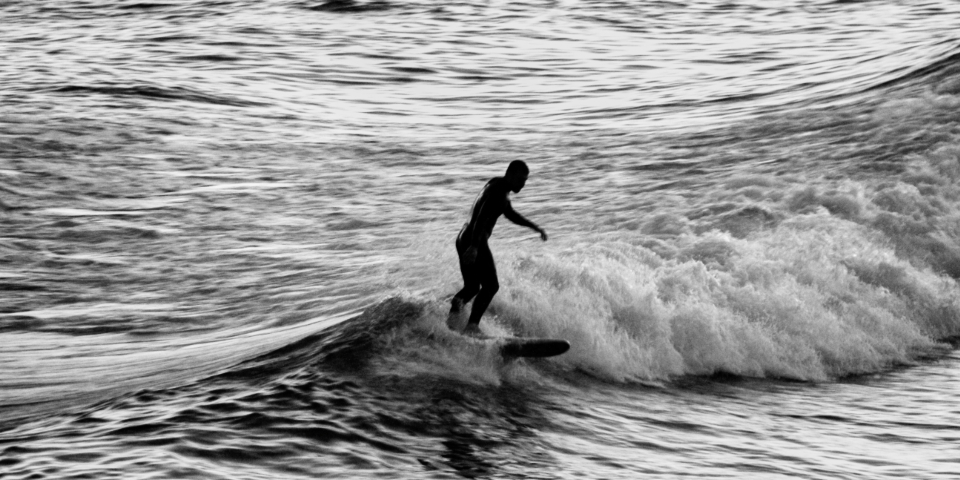
The book’s central claim is that there are two routes to any achievement: forcing it, or allowing it. Most of us default to force. Dodson makes the case that flow lives entirely on the allowing side — a state of surrender in which you loosen your grip on thoughts, emotions and outcomes and trust your subconscious to do most of the work. It’s a reframing of effort itself: doing less, but doing it more skillfully. Where his earlier manifestation books asked you to steer, this one asks you to get out of your own way.
Six doorways into flow
Across its chapters the book keeps returning to a handful of practical levers. These are the ones most readers can put to use straight away:
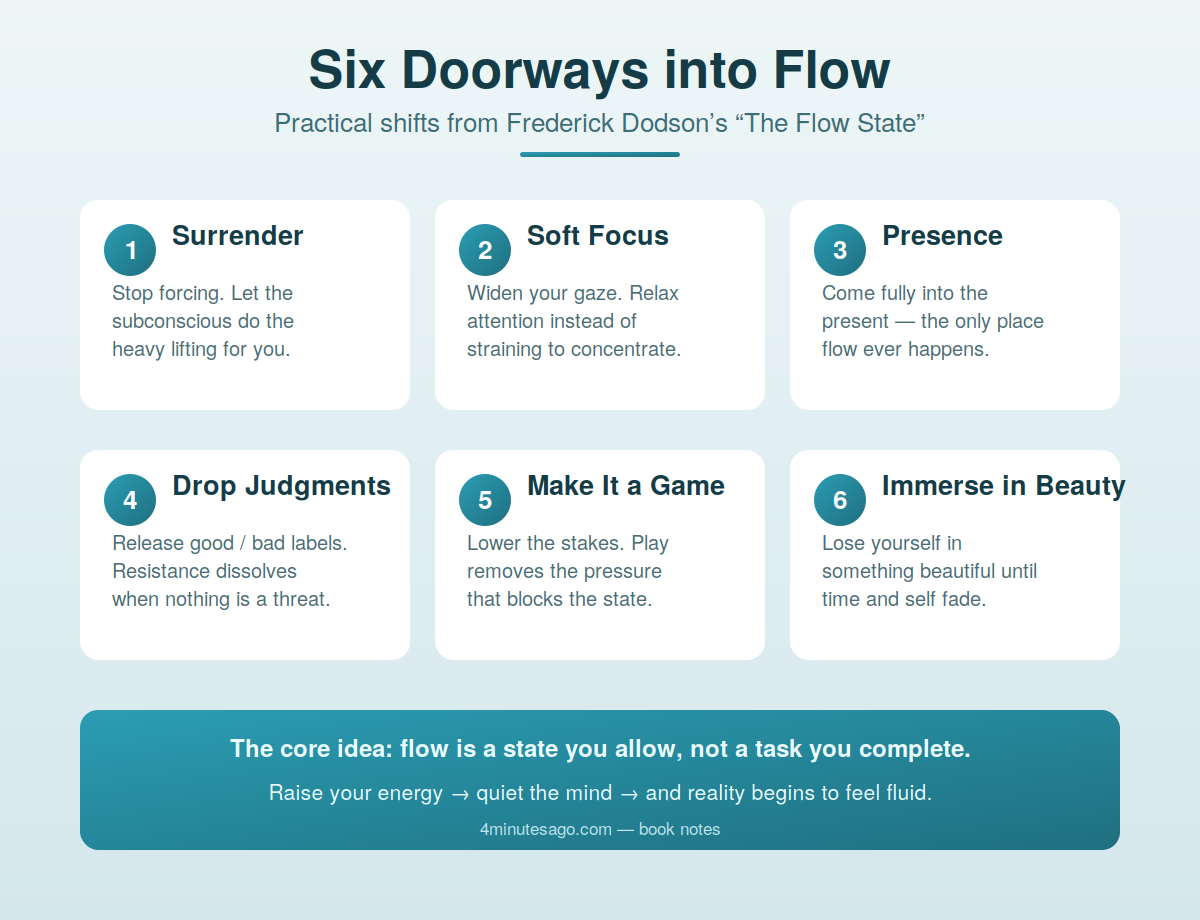
- Surrender — stop forcing outcomes and let the subconscious carry the load.
- Soft focus — widen your attention instead of straining to concentrate on a single point.
- Presence — drop fully into the present moment, the only place flow ever occurs.
- Releasing judgments — let go of good/bad labelling so nothing registers as a threat.
- Treat it as a game — lower the stakes so pressure stops blocking the state.
- Beauty immersion — lose yourself in something beautiful until time and self fade.
A sample exercise you can try now
One representative exercise is beauty immersion. Find something genuinely beautiful nearby — an object, a plant, a view — and give it your full, unhurried attention. Look so closely and with such interest that you briefly lose track of time, space and yourself. Dodson suggests staying with it, and a few other beautiful things, for roughly half an hour or until you notice a clear shift in your state. The point isn’t the object; it’s rehearsing the quality of absorbed, judgment-free attention that flow depends on.
An honest take
The Flow State is practical and refreshingly light on theory — readers repeatedly praise how exercise-driven it is, and that is its real strength. It’s also worth reading with clear eyes. Dodson blends grounded technique with some sweeping anecdotes about near-miraculous feats attributed to the state, which more skeptical readers find a stretch, and the book makes no claim to scientific rigour. If you want the research-backed treatment of the same phenomenon, Mihaly Csikszentmihalyi’s classic Flow is the natural companion. Dodson’s book is best approached as an experiential toolkit rather than a study.
The takeaway
The most useful idea in the book is also the simplest: flow is a state you allow, not a task you complete. If you tend to push through everything by sheer effort, the invitation here is to experiment with the opposite — soften your focus, drop the judgments, and let performance come to you. You don’t have to accept every claim to get value from the exercises. Pick one, try it this week, and notice what happens when you stop trying so hard.