
Choosing between Bright Data and Oxylabs is one of the most common decisions teams face when they need serious web data at scale. Both are enterprise-grade leaders, both offer the full stack — residential proxies, scraper APIs, and ready-made datasets — and neither is the cheapest option on the market. This guide breaks down how they compare so you can pick the right one for your use case instead of your budget’s worst case.
The 20-second verdict. Choose Bright Data for product breadth, the largest raw IP pool, and pay-as-you-go flexibility — the safer pick for large or unpredictable multi-source pipelines. Choose Oxylabs for a lower entry price, a genuinely free tier, and a compliance-first posture — the friendlier start when you want predictable per-result costs and a clean legal story.
What each platform actually is
Bright Data — the heavyweight
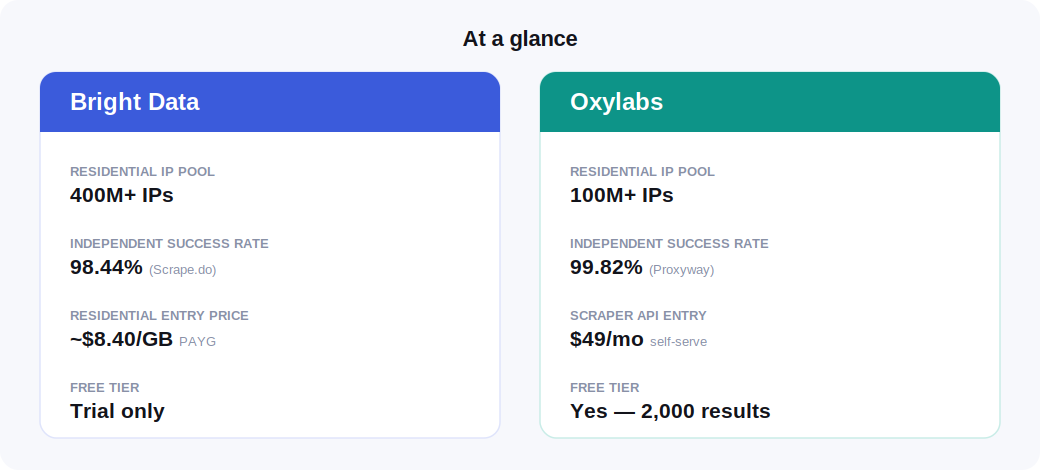
Bright Data is the largest and most feature-complete player in the web-data world. It runs one of the biggest residential networks in the industry — its own current figures cite 400M+ IPs across 195 countries — and pairs that with 437+ pre-built scrapers, a Web Unlocker, SERP and Browser APIs, and a large dataset marketplace. In an independent 11-provider benchmark run by Scrape.do, Bright Data posted the highest average success rate of the group at 98.44%. Its defining commercial trait is flexibility: most products are available pay-as-you-go with no monthly minimum, so you can scale from a small SERP package to an enterprise pipeline on one account.
Oxylabs — the compliance-first challenger
Oxylabs is Bright Data’s closest enterprise competitor. Founded in Lithuania in 2015, it operates 100M+ residential IPs across 195 countries, an AI-assisted parser called OxyCopilot, and the same full proxy-plus-scraper stack. It leans hard into compliance — it’s a member of the Ethical Web Data Collection Initiative and runs KYC checks on new accounts — and it consistently scores at the very top of independent reliability tests, including a 99.82% residential success rate in Proxyway’s 2024 benchmark and near-perfect ISP-proxy numbers. Crucially for smaller teams, Oxylabs offers a free tier and a $49/month self-serve entry point, which Bright Data doesn’t match.
Head-to-head comparison
| Dimension | Bright Data | Oxylabs |
|---|---|---|
| Residential IP pool | 400M+ across 195 countries | 100M+ across 195 countries |
| Product breadth | 437+ pre-built scrapers, Unlocker, SERP, Browser API, datasets | Full proxy + Scraper API stack, OxyCopilot AI parser, datasets |
| Independent success rate | 98.44% (Scrape.do, 11-provider set) | 99.82% residential; ~99.98% ISP (Proxyway) |
| Residential proxy price | From ~$8.40/GB pay-as-you-go, no minimum | ~$4/GB at scale up to ~$15/GB at entry (tiered) |
| Scraper API entry | Pay-as-you-go from ~$1.50 / 1,000 records, no monthly minimum | From $49/mo self-serve; better per-result rates at volume |
| Datacenter proxies | ~$0.60–0.90 / IP | ~$0.08–0.20 / IP |
| Free tier / trial | Trial only (no free tier) | Free tier up to 2,000 results + 7-day trial (KYC) |
| Pricing model | Consumption-based across many product lines | Mostly bandwidth (per-GB) + committed monthly tiers |
| Compliance | GDPR/CCPA, DPAs, ethical sourcing program | GDPR/CCPA, DPAs, EWDCI member, KYC on new accounts |
| Best for | Broad, high-volume, multi-source pipelines wanting max flexibility | Cost-sensitive starts, compliance-led reviews, top ISP/mobile reliability |
Pricing, compared honestly
The two providers price differently enough that the „cheaper“ one depends entirely on your volume and the shape of your workload. Bright Data bills most products pay-as-you-go: residential proxies start around $8.40/GB with no commitment, and its Web Scraper API runs from roughly $1.50 per 1,000 records with no monthly minimum. That’s attractive for variable or exploratory work where you don’t want to sign up for a subscription.
Oxylabs leans on committed monthly tiers. Its Scraper API starts at $49/month with better per-result rates as you commit to higher volumes, and residential pricing ranges from about $4/GB at scale up to roughly $15/GB at the entry tier, depending on which plan and source you check. The honest way to compare the two isn’t the sticker price at all — it’s effective cost per successful request: price per GB divided by your real success rate on your actual target sites. A slightly pricier proxy that succeeds far more often on your targets is usually the cheaper one in practice.
Where each one wins
Bright Data
- Broadest product line — proxies, scrapers, unlocker, datasets in one place
- Largest raw IP pool and top score in an independent multi-provider benchmark
- Pay-as-you-go with no monthly minimum — scales up or down freely
- Watch-out: consumption pricing across many lines is hard to predict and budget
- Watch-out: no free tier — trial access only
Oxylabs
- Low $49/mo entry point plus a genuinely free tier for testing
- Elite ISP and mobile-proxy reliability in independent benchmarks
- Compliance-first posture (EWDCI membership, KYC) that eases legal review
- Watch-out: bandwidth-based pricing can be unpredictable when scraping many small pages
- Watch-out: higher tiers are sales-gated, and its scraper API tested slower than its proxies in some benchmarks
So which should you choose?
Pick Bright Data if you need the broadest toolset, expect to pull from many different sources, or want pay-as-you-go flexibility without a monthly commitment. Pick Oxylabs if you’re cost-sensitive at the entry level, value a documented compliance and KYC posture for a legal review, or your targets favour its top-tier ISP and mobile reliability.
For most teams, though, the deciding factor isn’t the spec sheet — it’s which platform actually succeeds more often on your specific URLs. Both offer trials, so the smartest move is to run the same 100–200 target pages through each, measure success rate and cost side by side, and let your own data settle the debate before you commit to a contract.
The bottom line
Bright Data and Oxylabs sit at the top of the web-data market for good reason: both are reliable, compliant, and built for scale. Bright Data edges ahead on breadth and flexibility; Oxylabs on entry price and compliance polish. Benchmark your real workload on both trials, compare effective cost per successful request, and choose the one that clears your targets most consistently.
A note on the numbers: pricing and benchmark figures here reflect representative rates and independent tests published as of mid-2026. Both vendors change plans frequently and run promotions, and benchmark results vary by methodology — always confirm current rates on each provider’s official pricing page before you buy.
